

Why Diesel Can Be $7 When Crude Is Still Below Its 2008 Peak
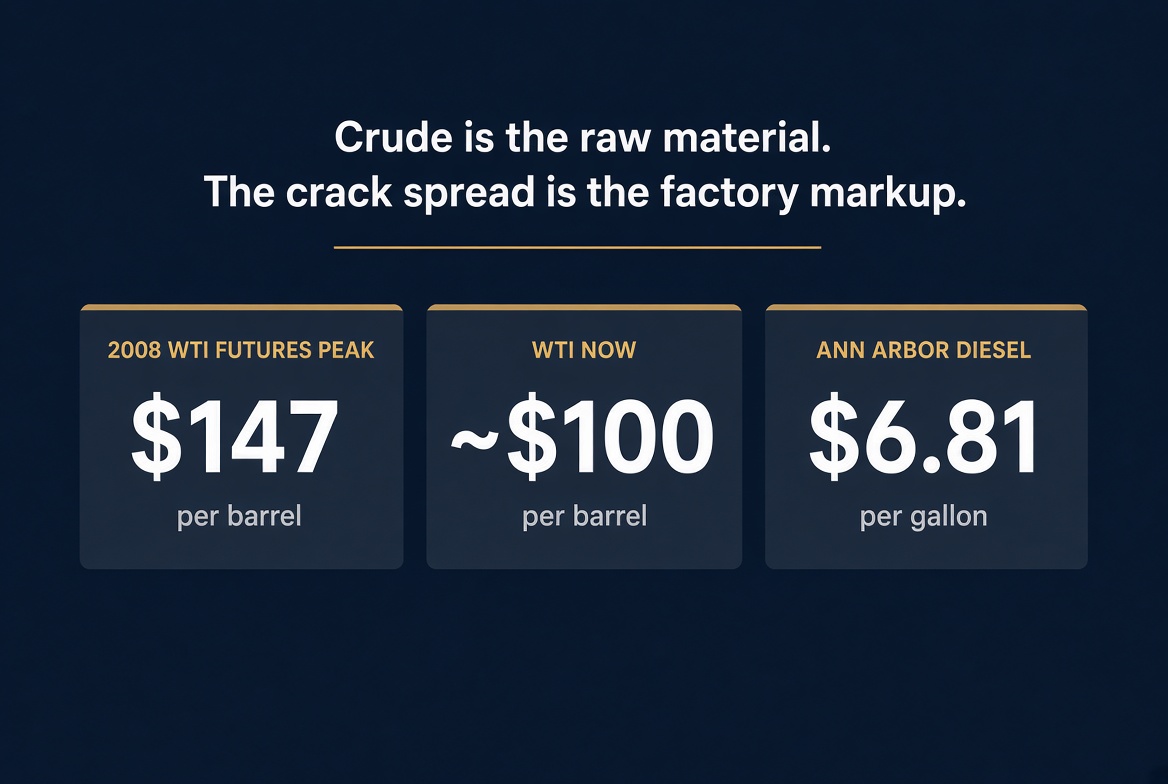
Crude is still below the 2008 peak of $147. Ann Arbor diesel is $6.81. Those two facts can both be true — because pump prices are not just the barrel. They’re the barrel plus the crack spread, taxes, and local supply.
Someone in Ann Arbor claimed to see unleaded at $6 and diesel at $8 and treated that one station as a verdict on U.S. policy toward Iran. That is a bumper sticker, not a market.
TL;DR
AAA’s Ann Arbor average as of September 19 is about $4.97 regular and $6.81 diesel. Michigan regular is about $4.93. The national regular average is about $4.48. Those prices are high. Diesel in particular is ugly. High prices still do not mean the pump is priced off a Tehran headline.
Consumers do not buy crude. They buy gasoline and diesel. Those products are priced on futures boards — WTI in New York, Brent in London — then marked up through refiners, pipelines, terminals, retailers, and taxes. The missing piece in most political arguments is the crack spread: the refiner’s margin between a barrel of crude and the fuels cracked out of it.
A wide crack is how diesel can explode while crude is only elevated. That is the factory markup, not an indictment on Trump’s actions in Iran.
What a crack spread is
The crack spread is the difference between what refined products sell for and what the crude used to make them costs. “Crack” comes from cracking — breaking long crude molecules into gasoline, diesel, jet, and other products.
- A narrow crack means product prices are not much above crude. Refiners have little reason to run hard.
- A wide crack means products are scarce relative to crude. Refiners want to run every unit they can.
It is a gross margin proxy, not net profit. Power, hydrogen, labor, maintenance, and transport still come out of that number.
The 3-2-1 formula traders use
A common model of a U.S. refinery is:
- 3 barrels of crude in
- 2 barrels of gasoline out
- 1 barrel of diesel / heating oil out
Gasoline and diesel futures are quoted in dollars per gallon. Crude is quoted in dollars per barrel. There are 42 gallons in a barrel, so products get multiplied by 42 first.

That gives dollars of gross margin per barrel of crude processed.
The diesel-only version is even simpler:

That diesel crack is the one that blows out when the pump price for diesel runs far ahead of gasoline.
Why diesel can spike without “Iran oil disappearing”
A refinery cannot freely convert every extra barrel of crude into extra diesel. Distillation towers, hydrocrackers, and hydrotreaters have physical limits. Once the system is already running near full tilt, a wider crack pays refiners more. It does not create spare capacity.
That is the current bind:
- EIA has U.S. refinery utilization in the high 97s recently — 97.5% for the week ending September 11, 2026. Midwest plants have been at or above 100% of operable capacity
- Distillate inventories have been thin
- Russian diesel exports are constrained by the Ukraine war
- Product tankers and export pull can tighten diesel even when crude is available
So crude can sit around $100 while the diesel crack is $80–$110 a barrel. The extra dollars at the pump are a refined-product shortage, not just the barrel of oil in the ground.
What actually hits the sticker
Retail gasoline and diesel lag futures by days to a few weeks, then add:
- distribution and marketing
- state and federal tax
- local station margins and regional bottlenecks
Michigan’s fuel tax is not free. Federal tax is another 18.4 cents. A single Ann Arbor pump can look worse than the national average even when the cause is a wide distillate crack on the futures board.
Brent and WTI are also political markets. London and New York price fear, shipping risk, and expected supply months out. A headline can move diesel before a single extra barrel is lost. Energy pain has a habit of showing up on the election calendar. That is how commodity markets work. It is not the same thing as “every gallon is Trump’s Iran policy.”
If you’d like more information on the effect of the Iran war and what’s really going on globally, checkout Promethean Action’s Midweek Update from September 17, 2026.
Related Articles
More articles you might be interested in
Legislative Updates : 2026-04-02
Holding drug dealers accountable and outlawing "gas station heroine"

Legislative Updates : 2026-02-05, Tax Relief
Government moves slowly, sometimes tending toward the right direction. House Republicans are putting real dollars back in the pockets of Michigan residents. Now... how about a bill to end property tax?
Legislative Updates : 2026-01-29, Thank you for your attention!
Cell phones are distracting our kids from learning and interacting with one another. It's time to kick 'em out of the classrooms.